NiralOS Disaster Management Solution is a provisioned, rapidly deployable private 5G emergency communication network from Niral Networks. It gives ordinary citizens a simple way to reach help by dialing 112 (India) or 911 (US), while giving emergency responders — police, fire, medical and disaster-response teams — a secure, mission-critical private 5G network with edge AI and a unified emergency command centre, so operations continue even when public networks, power or internet connectivity are down.
Executive Summary
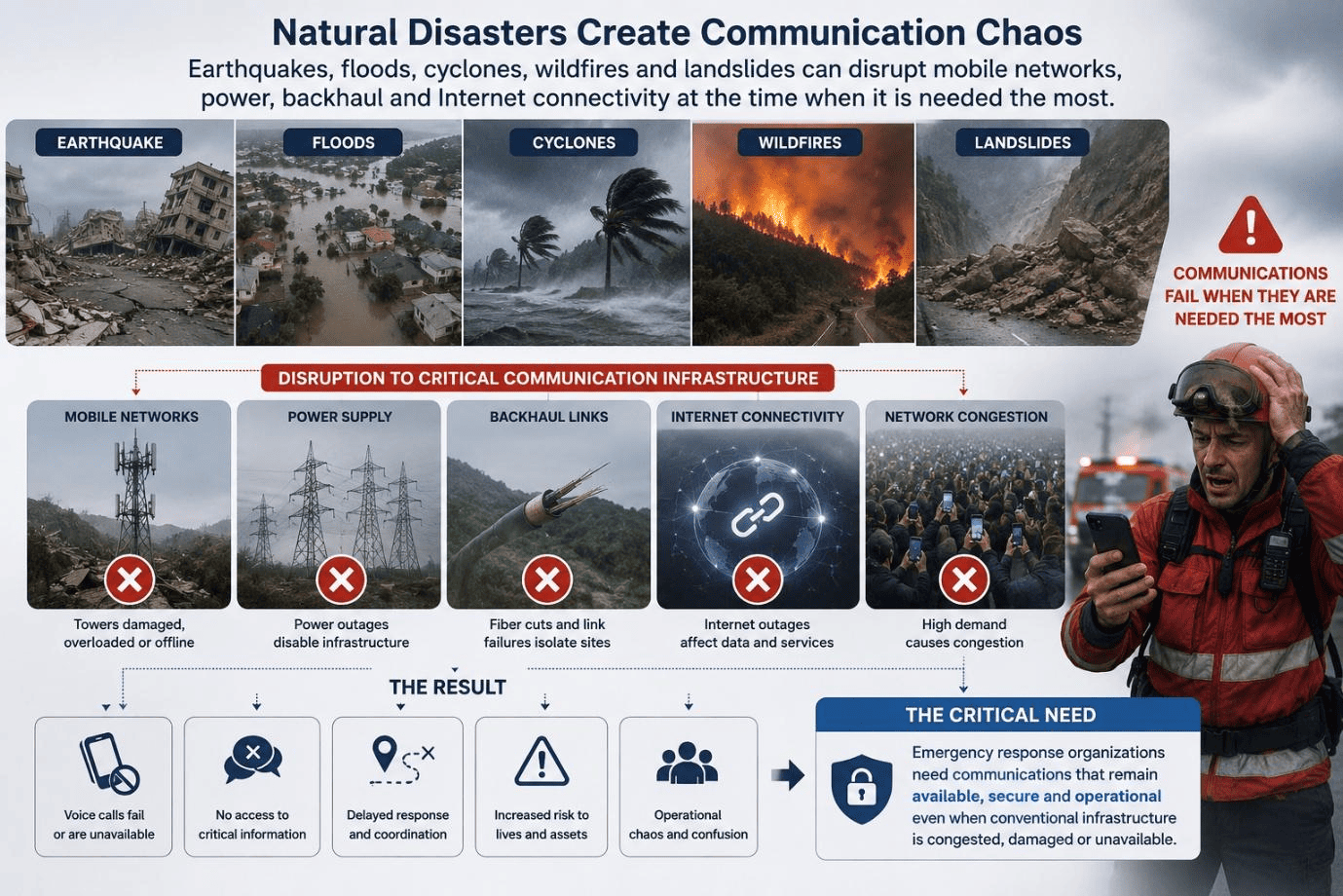
Natural disasters—including earthquakes, floods, cyclones, wildfires and landslides—can disrupt mobile networks, power, backhaul and Internet connectivity at precisely the time when communication is most critical. Emergency response organizations need communications that remain available, secure and operational even when conventional infrastructure is congested, damaged or unavailable.
Click Image to View
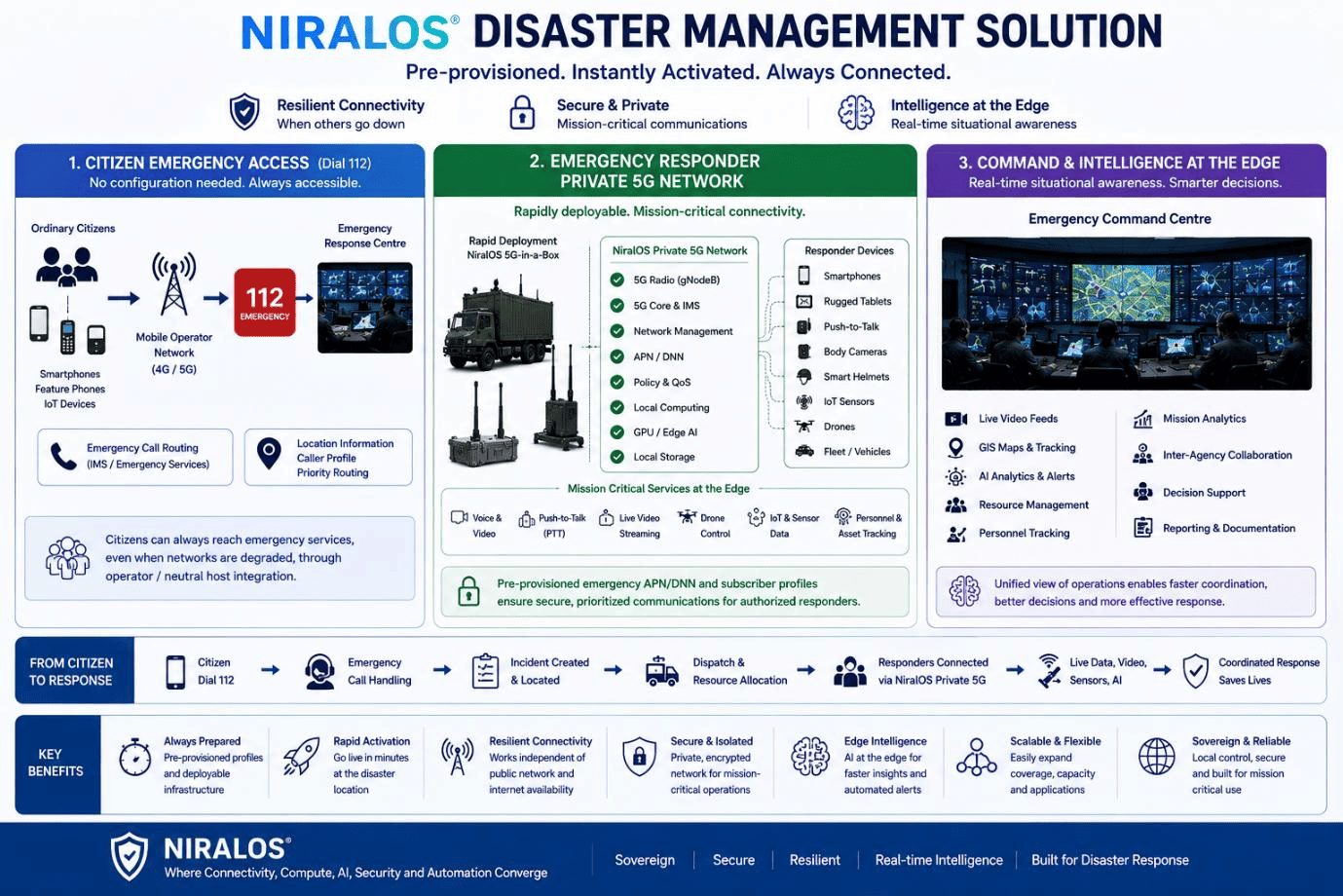
NiralOS Disaster Management Solution provides a two-layer communications architecture that addresses both ordinary citizens requiring emergency assistance and authorized emergency responders requiring mission-critical Private 5G connectivity.
The solution combines:
Citizen Emergency Access — ordinary citizens can continue to use the existing emergency-service mechanism, such as dialing 112 in India/911 in the US, without needing to configure an APN or install an application.
Emergency Responder Private 5G — police, fire, medical, disaster-response and other authorized personnel can use a pre-provisioned Emergency Network and rapidly deployable NiralOS Private 5G infrastructure.
Edge AI & Computing — local processing of video, sensor and operational data enables real-time intelligence even when cloud or Internet connectivity is unavailable.
Emergency Command & Control — a unified platform brings together emergency calls, field teams, video, drones, sensors, analytics and resource tracking.
Click Image To View
1. The Disaster Communication Challenge
During a major disaster, communication infrastructure can fail in several ways:
Mobile towers may lose power.
Fibre and backhaul links may be damaged.
Public networks may become congested.
Internet connectivity may be unavailable.
Emergency responders may operate outside normal network coverage.
Large volumes of video and sensor data may overwhelm centralized infrastructure.
Multiple agencies may lack a common communications and intelligence platform.
Conventional disaster recovery often focuses on restoring damaged communications infrastructure. NiralOS introduces a complementary approach:
APPROACH
Pre-provision the emergency communications capability and rapidly deploy it at the location where it is needed.
This creates a resilient digital infrastructure for emergency operations rather than waiting for normal infrastructure to recover.
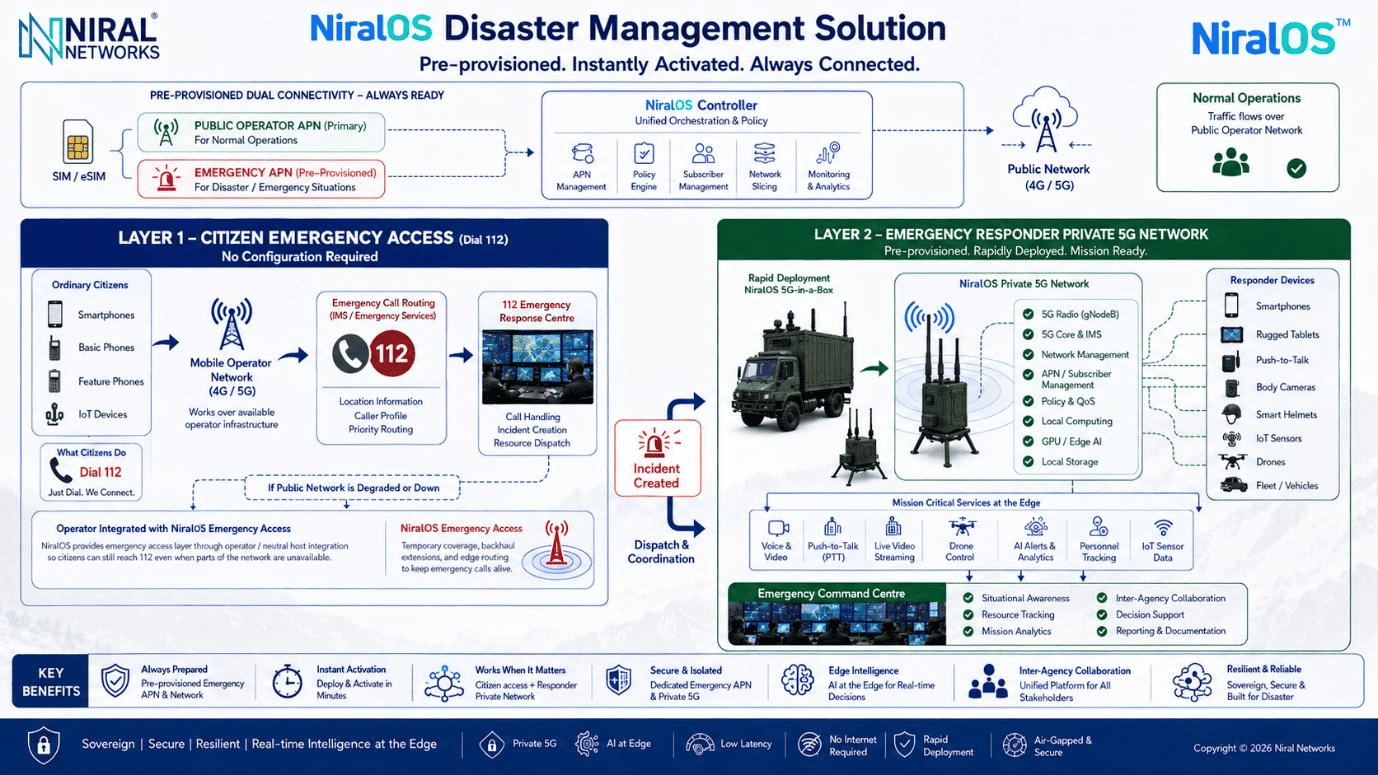
The NiralOS solution separates disaster communications into two operational layers.
Click Image To View
Layer 1 — Citizen Emergency Access
Ordinary citizens should not be required to understand Private 5G, APNs or network configuration.
In India, a citizen can simply:
Dial 112
The emergency call follows the available operator/emergency-services infrastructure and is routed to the appropriate emergency response centre.
The citizen experience remains simple:
Phone → Dial 112 → Emergency Response Centre
NiralOS can participate in the broader emergency-access architecture through appropriate mobile-operator, emergency-services and neutral-host/network integration.
Where portions of the public network are degraded, an appropriately engineered NiralOS emergency-access layer can provide temporary local connectivity and routing capabilities, subject to operator and regulatory integration.
CITIZEN PRINCIPLE
No application. No manual APN configuration. No technical knowledge required.
Layer 2 — Emergency Responder Private 5G
Emergency responders have fundamentally different requirements from ordinary citizens.
They require:
Secure communications
Priority traffic
Push-to-talk
Live video
Drone connectivity
Personnel tracking
Sensor connectivity
Mission applications
Low-latency communications
Local AI
Secure command and control
For these users, NiralOS provides a pre-provisioned Emergency Network profile and rapidly deployable Private 5G infrastructure.
Authorized responder SIMs/eSIMs can be configured with:
PRIMARY NETWORK
Public Operator APN → Public 4G/5G
EMERGENCY NETWORK
Emergency APN/DNN → NiralOS Private 5G
The Emergency APN/DNN is only one component of the solution. The complete emergency-access architecture includes the appropriate SIM/eSIM credentials, network/PLMN access, authentication, APN/DNN, Private 5G RAN, NiralOS 5G Core, IMS, Application Orchestration.
3. From Disaster Event to Operational Network
The NiralOS architecture follows a pre-planned operational workflow.
1. Pre-Provision Before a disaster occurs:
Emergency SIMs/eSIMs are provisioned.
Emergency APN/DNN is configured.
Subscriber identities are authorized.
QoS and policy profiles are established.
Emergency applications are defined.
NiralOS portable Private 5G equipment is maintained in a ready-to-deploy configuration.
2. Disaster Occurs
An earthquake, flood, cyclone, wildfire or other disaster impacts the region.
Emergency authorities activate their disaster-response plan.
3. Deploy NiralOS Private 5G A portable NiralOS Private 5G Tactical Appliance is transported to the affected area.
NiralOS Private 5G Tactical Appliance can integrate:
5G Radio / gNodeB
5G Core
IMS
NMS and Orchestration
Subscriber management
APN/DNN management
Policy and QoS
Local compute
GPU acceleration
Local storage
Edge AI
Click Image To View
4. Establish Emergency Coverage
The temporary Private 5G network establishes a localized communications zone.
Authorized responder devices connect to the network according to their configured access policies.
5. Connect Field Assets
The network can support – Smartphones, Rugged tablets, Push-to-talk devices, Body cameras, Smart helmets, Drones, Ground sensors, Portable cameras, Ambulances, Emergency vehicles, IoT devices
6. Command and Control
Field information is aggregated into the NiralOS Emergency Command Centre, providing a common operational picture.
4. Citizen-to-Responder Emergency Workflow
One of the most important capabilities is connecting a citizen’s emergency request with the appropriate response team.
A typical earthquake scenario could operate as follows:
Citizen: → Dial 112 → Emergency Call Handling → Incident Created → Location / Caller Information → Emergency Response Centre → Dispatch & Coordination → NiralOS Private 5G → Police / Fire / Medical / Rescue Team → Live Video + Voice + Drone + Sensors → Emergency Command Centre
This creates a bridge between the public emergency-access ecosystem and the mission-critical responder network.
The citizen does not need to know whether the responding organization uses NiralOS.
5. NiralOS Edge AI for Disaster Intelligence
Disaster response generates enormous volumes of information. Drones may generate video. Body cameras generate live feeds. Sensors generate telemetry. Rescue personnel generate location and operational data. Sending all this information to a remote cloud may be impractical when connectivity is disrupted.
NiralOS therefore brings compute, storage and AI closer to the point of action.
Potential Edge AI applications include:
Search-and-rescue assistance
Person detection
Crowd detection
Fire and smoke detection
Flood monitoring
Infrastructure damage assessment
Vehicle detection
Restricted-zone monitoring
Anomaly detection
Environmental monitoring
Automated alerts
For example:
Drone → Private 5G → NiralOS Edge GPU → AI Analysis → Alert → Command Centre
Only relevant intelligence or selected video streams need to be transmitted to remote infrastructure.
This reduces bandwidth requirements while accelerating operational decision-making.
6. NiralOS Controller
The NiralOS Controller provides centralized orchestration of the emergency network.
Key capabilities include:
APN/DNN management
Subscriber provisioning
SIM/eSIM management
Policy management
QoS management
Network slicing
RAN configuration
Network monitoring
Analytics
Role-based access control
Multi-site orchestration
Service management
This enables disaster-management authorities to operate the Private 5G environment through a unified management layer.
7. Emergency Command Centre
The NiralOS Emergency Command Centre provides a unified operational view of the disaster response.
It can bring together:
Communications
Voice
Video
Push-to-talk
Emergency communications
Situational Awareness
Live drone feeds
Body-camera feeds
Maps
Sensor data
Personnel locations
Intelligence
AI alerts
Video analytics
Mission analytics
Incident analysis
Coordination
Team tracking
Resource management
Dispatch
Inter-agency collaboration
This transforms the emergency network from a simple connectivity platform into an operational intelligence platform.
8. Security, Resilience & Sovereignty
Disaster communications may involve sensitive information and mission-critical operations.
NiralOS is designed around:
Secure&Isolated
Emergency communications can be logically separated from normal public traffic through dedicated network policies, APNs/DNNs and Private 5G infrastructure.
Local&Sovereign
Critical compute, storage and AI workloads can operate locally, reducing dependence on external cloud infrastructure.
Resilent
The temporary Private 5G network can provide localized connectivity even when conventional public-network or Internet services are degraded, subject to local power, radio coverage and backhaul availability.
Low Latency
Local applications and Edge AI can reduce dependency on remote processing.
Rapid Deployment
A portable NiralOS appliance can provide the foundation for a temporary communications and computing environment at the disaster location.
9. Key Benefits
Capability
Benefit
Citizen Emergency Access
Citizens can use the established emergency-service mechanism without technical configuration
Pre-Provisioned Emergency Network
Emergency capability is prepared before the disaster
Local control of critical communication, compute and data
10. Conclusion
Disaster management requires a communications architecture that serves both sides of the emergency equation:
Citizens need a simple way to call for help.
Responders need a resilient network to deliver that help.
NiralOS addresses both requirements through a two-layer architecture.
Citizen Emergency Access preserves a simple emergency-calling experience, such as dialing 112, through the appropriate operator and emergency-services ecosystem.
At the same time, NiralOS Private 5G provides authorized emergency responders with a rapidly deployable, secure and resilient communications infrastructure. Pre-provisioned Emergency Network profiles, portable 5G infrastructure, Edge AI, local computing and an integrated command centre enable emergency organizations to continue operating even when conventional infrastructure is severely degraded.
The resulting architecture creates a complete disaster-management platform:
It’s a two-layer emergency communications architecture from Niral Networks that combines simple citizen emergency access (dialing 112 or 911) with a pre-provisioned, rapidly deployable private 5G network for authorized emergency responders, supported by edge AI and a unified emergency command centre.
How does private 5G help disaster response?
Private 5G gives emergency responders a secure, prioritized, low-latency network that works independently of the public network and internet availability — supporting push-to-talk, live video, drone connectivity, personnel tracking, sensor data and mission-critical applications.
How do citizens contact emergency services when networks are down?
No app or configuration is needed. Citizens simply dial the existing emergency number — 112 in India or 911 in the US — and the call routes through available operator or emergency-services infrastructure to the appropriate response centre.
What is Edge AI used for in disaster management?
Edge AI processes video, sensor and operational data locally at the disaster site rather than relying on a remote cloud, enabling search-and-rescue assistance, person and crowd detection, fire and smoke detection, flood monitoring, infrastructure damage assessment and automated alerts — even without internet connectivity.
What does the NiralOS Private 5G Tactical Appliance include?
The portable appliance can integrate a 5G Radio/gNodeB, 5G Core, IMS, network management and orchestration, subscriber management, APN/DNN management, policy and QoS, local compute, GPU acceleration, local storage and edge AI — all deployable at the disaster location.
Is the NiralOS Disaster Management Solution secure and sovereign?
Yes. It’s designed to be secure and logically isolated from public traffic, with local and sovereign compute, storage and AI workloads that reduce dependence on external cloud infrastructure, while remaining resilient, low-latency and rapidly deployable.