

India Mobile Congress (IMC) 2023 Countdown Begins
Deployments
Partners
Customers
Countries
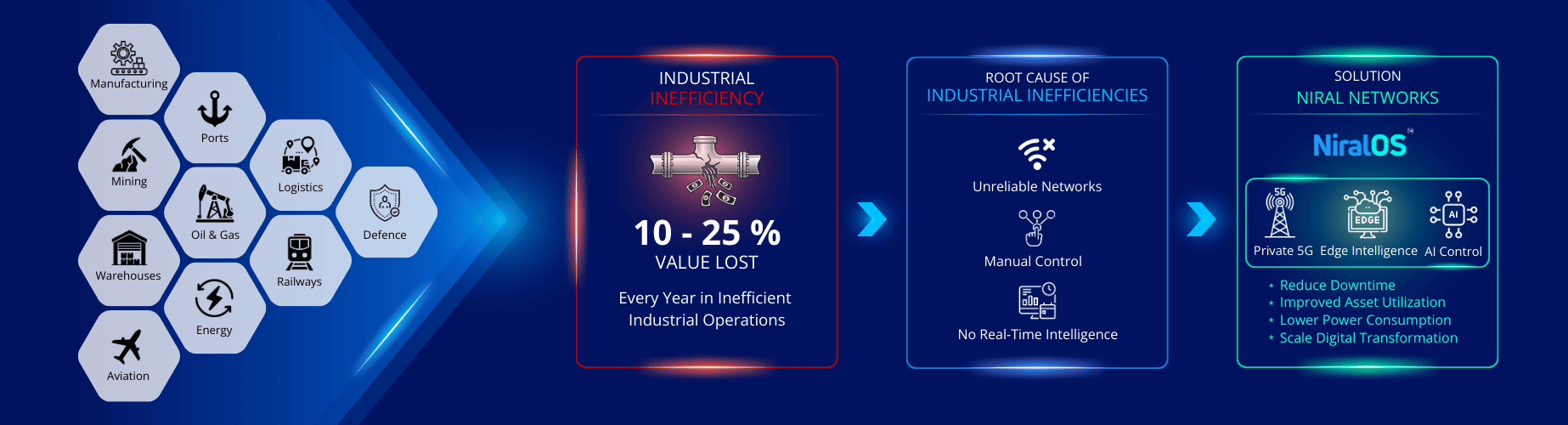
Industry 4.0 Deployment Challenge & Solution

Connectivity gaps (legacy Wi-Fi / Ethernet not scalable or reliable).
Fragmented OT/IT systems (silos, no unified orchestration).
Cybersecurity concerns slowing adoption.
Skills gap (shortage of AI/automation expertise).
Result: slower ROI, stalled pilots, uneven adoption.

Private 5G + Edge Computing + AI orchestration:
Reliable connectivity: low-latency, deterministic networks for robotics, AGVs, sensors.
Unified platforms (like NiralOS): integrate OT + IT with automation.
Air-gapped & secure by design: resilient to cyber attacks.
Open ecosystem: APIs for easy integration with MES, ERP, AI apps.
Pilot deployments prove feasibility: industrial partners see value.
Scale from pilots to production across plants, railways, mines, or defense sites.
Continuous optimization with NWDAF-driven analytics (predictive maintenance, energy efficiency).
Ecosystem partnerships (OEMs, integrators, cloud/edge providers).
Skill development & training to ensure sustainable adoption.
Outcome: full Industry 4.0 transformation – autonomous, data-driven, secure enterprises.

Connectivity gaps (legacy Wi-Fi / Ethernet not scalable or reliable).
Fragmented OT/IT systems (silos, no unified orchestration).
Cybersecurity concerns slowing adoption.
Skills gap (shortage of AI/automation expertise).
Result: slower ROI, stalled pilots, uneven adoption.
Private 5G + Edge Computing + AI orchestration:
Reliable connectivity: low-latency, deterministic networks for robotics, AGVs, sensors.
Unified platforms (like NiralOS): integrate OT + IT with automation.
Air-gapped & secure by design: resilient to cyber attacks.
Open ecosystem: APIs for easy integration with MES, ERP, AI apps.
Pilot deployments prove feasibility: industrial partners see value.
Scale from pilots to production across plants, railways, mines, or defense sites.
Continuous optimization with NWDAF-driven analytics (predictive maintenance, energy efficiency).
Ecosystem partnerships (OEMs, integrators, cloud/edge providers).
Skill development & training to ensure sustainable adoption.
Outcome: full Industry 4.0 transformation – autonomous, data-driven, secure enterprises.
Implementation Gap
In the Industry 4.0 landscape, connectivity is king. Private 5G ensures that every sensor, machine, and device on the factory floor remains connected, enabling real-time data flow and decision-making. Autonomous guided vehicles (AGVs) navigate flawlessly, coordinating with robotic arms and smart inventory systems in a seamless dance of productivity.
The ultra-low latency of Private 5G enables critical applications like remote-controlled robotics and augmented reality maintenance. Technicians can guide repairs from across the globe as if they were standing right next to the machine, drastically reducing downtime.
In an era where industrial espionage and cyber threats loom large, Private 5G creates a secure enclave for your most sensitive operational data. Proprietary manufacturing processes and valuable intellectual property remain protected, allowing you to innovate with confidence.
While the upfront costs of Private 5G implementation may seem daunting, the return on investment (ROI) is compelling. Studies show that Private 5G can lead to a 20-30% increase in overall productivity, with some manufacturers reporting up to 50% reduction in downtime. The ability to connect seamlessly without interruptions translates directly to improved output and efficiency.
Machine learning models can be updated instantly across the entire production line, ensuring that every process is optimized continuously.
Bridging the Gap
without the need to send it to distant servers. In practice, this enables applications like:
- Instantaneous quality control using computer vision
- Real-time optimization of energy consumption
- Predictive maintenance that anticipates failures before they occur
WiFi vs 5G: The Cost & Performance Reality
Comparing connectivity solutions for industrial sites covering 4 square kilometers reveals significant differences in deployment costs and capabilities
Private 5G | WiFi | Ethernet | Satellite | |
Wireless & Mobility Coverage | Best – Indoor & Outdoor | Best Indoor | No | Good Outdoor |
Base Station Coverage | 5G Radio (depends on band) – 500 m to 1 km | WiFi AP – 30 to 50 m | NA | LEO Satellite – 50 to 200 km |
Privacy & Security | SIM-based, Encrypted | Limited, Password-based | Not Encrypted | Typically Encrypted |
Speed/Bandwidth | 500 Mbps – (UL 200 Mbps, DL 600 Mbps) | 200 Mbps – Reduces with more devices | 1 Gbps+ | 10-30 Mbps |
Real-time Latency | <10 ms – Consistent | 10-20 ms – Highly Inconsistent | < 2ms | Not Ideal |
Reliability | Deterministic, Guaranteed QoS | Best-effort | Best – Deterministic | Not Ideal |
Device Density | Scalable (200-500) per 5G Radio | Limited | Scalable | Not Ideal |
Industrial Connectivity | Excellent | Not Ideal | Good for non-mobility | Not Ideal |
Industry Use – Cases
Private 5G: Bridging the Gap to Industry 4.0
In the race towards Industry 4.0, manufacturers worldwide are seeking the key to unlock unprecedented levels of automation, efficiency, and innovation. The promise of smart factories, predictive maintenance, and adaptive production lines tantalizes industry leaders. Yet, a critical implementation gap stands between vision and reality. Enter Private 5G – the game-changing technology poised to bridge this divide and catalyze the Fourth Industrial Revolution.
The Dawn of Industry 4.0
Picture a factory floor where machines communicate in real-time, where AI-driven analytics predict maintenance needs before breakdowns occur, and where augmented reality guides workers through complex tasks. This isn’t science fiction—it’s the potential of Industry 4.0, and Private 5G is the backbone that makes it all possible.
The Implementation Gap: Challenges Facing Industry 4.0
Despite the allure of Industry 4.0, many manufacturers struggle to fully implement these advanced technologies. The reasons are multifaceted:
- Inadequate connectivity infrastructure
- Security concerns with existing networks
- Inability to handle massive data flows in real-time
- Lack of seamless integration between diverse systems and devices
Private 5G emerges as a powerful solution to these challenges, offering a robust foundation for Industry 4.0 applications.
Affordability
While the upfront costs of Private 5G implementation may seem daunting, the return on investment (ROI) is compelling. Studies show that Private 5G can lead to a 20-30% increase in overall productivity, with some manufacturers reporting up to 50% reduction in downtime. The ability to connect seamlessly without interruptions translates directly to improved output and efficiency.
Openness
One of the most significant advantages of Private 5G in the Industry 4.0 context is its unparalleled openness. This network can connect any hardware or software, from legacy systems to cutting-edge IoT devices. Whether you’re integrating a new AI-powered quality control system or connecting old machinery for data collection, Private 5G provides the flexible foundation you need.
Centralized Control & Management
Private 5G offers a simplified approach to managing complex industrial networks. From a single dashboard, operators can monitor and control every aspect of the production environment. This centralized management reduces complexity, minimizes training needs, and allows for rapid response to changing conditions—essential in the dynamic world of modern manufacturing.
Seamless Access & Mobility
In the Industry 4.0 landscape, connectivity is king. Private 5G ensures that every sensor, machine, and device on the factory floor remains connected, enabling real-time data flow and decision-making. Autonomous guided vehicles (AGVs) navigate flawlessly, coordinating with robotic arms and smart inventory systems in a seamless dance of productivity.
Real-time, Reliable Connectivity
The ultra-low latency of Private 5G enables critical applications like remote-controlled robotics and augmented reality maintenance. Technicians can guide repairs from across the globe as if they were standing right next to the machine, drastically reducing downtime.
Privacy & Security
In an era where industrial espionage and cyber threats loom large, Private 5G creates a secure enclave for your most sensitive operational data. Proprietary manufacturing processes and valuable intellectual property remain protected, allowing you to innovate with confidence.
The Power of Private 5G: Closing the Gap
In the Industry 4.0 landscape, connectivity is king. Private 5G ensures that every sensor, machine, and device on the factory floor remains connected, enabling real-time data flow and decision-making. Autonomous guided vehicles (AGVs) navigate flawlessly, coordinating with robotic arms and smart inventory systems in a seamless dance of productivity.
The ultra-low latency of Private 5G enables critical applications like remote-controlled robotics and augmented reality maintenance. Technicians can guide repairs from across the globe as if they were standing right next to the machine, drastically reducing downtime.
In an era where industrial espionage and cyber threats loom large, Private 5G creates a secure enclave for your most sensitive operational data. Proprietary manufacturing processes and valuable intellectual property remain protected, allowing you to innovate with confidence.
While the upfront costs of Private 5G implementation may seem daunting, the return on investment (ROI) is compelling. Studies show that Private 5G can lead to a 20-30% increase in overall productivity, with some manufacturers reporting up to 50% reduction in downtime. The ability to connect seamlessly without interruptions translates directly to improved output and efficiency.
One of the most significant advantages of Private 5G in the Industry 4.0 context is its unparalleled openness. This network can connect any hardware or software, from legacy systems to cutting-edge IoT devices. Whether you’re integrating a new AI-powered quality control system or connecting old machinery for data collection, Private 5G provides the flexible foundation you need.
In the Industry 4.0 landscape, connectivity is king. Private 5G ensures that every sensor, machine, and device on the factory floor remains connected, enabling real-time data flow and decision-making. Autonomous guided vehicles (AGVs) navigate flawlessly, coordinating with robotic arms and smart inventory systems in a seamless dance of productivity.
The ultra-low latency of Private 5G enables critical applications like remote-controlled robotics and augmented reality maintenance. Technicians can guide repairs from across the globe as if they were standing right next to the machine, drastically reducing downtime.
In an era where industrial espionage and cyber threats loom large, Private 5G creates a secure enclave for your most sensitive operational data. Proprietary manufacturing processes and valuable intellectual property remain protected, allowing you to innovate with confidence.
While the upfront costs of Private 5G implementation may seem daunting, the return on investment (ROI) is compelling. Studies show that Private 5G can lead to a 20-30% increase in overall productivity, with some manufacturers reporting up to 50% reduction in downtime. The ability to connect seamlessly without interruptions translates directly to improved output and efficiency.
One of the most significant advantages of Private 5G in the Industry 4.0 context is its unparalleled openness. This network can connect any hardware or software, from legacy systems to cutting-edge IoT devices. Whether you’re integrating a new AI-powered quality control system or connecting old machinery for data collection, Private 5G provides the flexible foundation you need.
In an era where industrial espionage and cyber threats loom large, Private 5G creates a secure enclave for your most sensitive operational data. Proprietary manufacturing processes and valuable intellectual property remain protected, allowing you to innovate with confidence.
Converging AI, Mobile Edge Compute, and SDN with NiralOS for Industry 4.0
The true power of Private 5G in Industry 4.0 applications comes from its seamless integration with other cutting-edge technologies:
Artificial Intelligence (AI)
With Private 5G, AI isn’t confined to centralized data centers. It’s distributed throughout the factory, making real-time decisions at the point of action.
Machine learning models can be updated instantly across the entire production line, ensuring that every process is optimized continuously.
Mobile Edge Computing (MEC)
MEC brings cloud computing capabilities to the edge of the network, right on the factory floor. This means data can be processed and analyzed in real-time
without the need to send it to distant servers. In practice, this enables applications like:
- Instantaneous quality control using computer vision
- Real-time optimization of energy consumption
- Predictive maintenance that anticipates failures before they occur
without the need to send it to distant servers. In practice, this enables applications like:
- Instantaneous quality control using computer vision
- Real-time optimization of energy consumption
- Predictive maintenance that anticipates failures before they occur
Software - Defined Networking
SDN adds a layer of intelligence and flexibility to the network itself. It allows for dynamic allocation of network resources based on real-time needs.
- Automatically prioritizing traffic for critical production processes
- Creating isolated network segments for sensitive operations
- Rapidly reconfiguring the network to support new production lines or temporary setups
The combination of AI, MEC, and SDN with Private 5G creates a responsive, intelligent network that can adapt to the ever-changing needs of modern manufacturing.
- Automatically prioritizing traffic for critical production processes
- Creating isolated network segments for sensitive operations
- Rapidly reconfiguring the network to support new production lines or temporary setups
The combination of AI, MEC, and SDN with Private 5G creates a responsive, intelligent network that can adapt to the ever-changing needs of modern manufacturing.
Use-case Integration: Industry 4.0 in Action
Private 5G enables a wide range of Industry 4.0 applications:
Robotics & Automation
AI Vision & Quality Inspection
AGV & AMRs
Worker Safety
Predictive Maintenance
Energy Optimization
Cybersecurity & OT Isolation
Surveillance
Push To Talk
Drone Monitoring
Digital Twins
Create virtual replicas of your entire production line, allowing for simulation and optimization without disrupting actual operations.
Remote Operations
Technicians use AR glasses to access real-time data and guided instructions, dramatically reducing repair times and errors.
Robotics & Autonomous Systems
Self-driving vehicles and drones handle material movement within the factory, optimizing flow and reducing waste.
Predictive Maintenance
Worker Safety
Resilient to Cyber Attacks
The Road Ahead:
From Implementation Gap to Market Leader
The journey to Industry 4.0 is not without its challenges, but Private 5G provides the robust foundation needed to overcome them. By addressing key issues of connectivity, security, and data management, it allows manufacturers to fully embrace the potential of smart factories.
As we stand on the brink of this new industrial era, the question is no longer if Industry 4.0 will transform manufacturing, but who will lead the charge. With Private 5G, you have the power to not just close the implementation gap, but to leap ahead of the competition.
Watch video
Are you ready to transform your factory floor into a beacon of Industry 4.0 innovation?
We Are Trusted Partners For


Upgrade to NiralOS 5G & EDGE AI